Real-time video from freefall.
Spectators, the waiting crowd, her own team — they follow her jump with the naked eye. The footage arrives only after landing. The moment itself stays invisible.
Until now the footage was always late. We bring the view from the jump down to the ground — in the same instant. Not as a recording. As the present.
Its own radio link, no internet. The HDMI cable goes straight to the big TV in the waiting area.
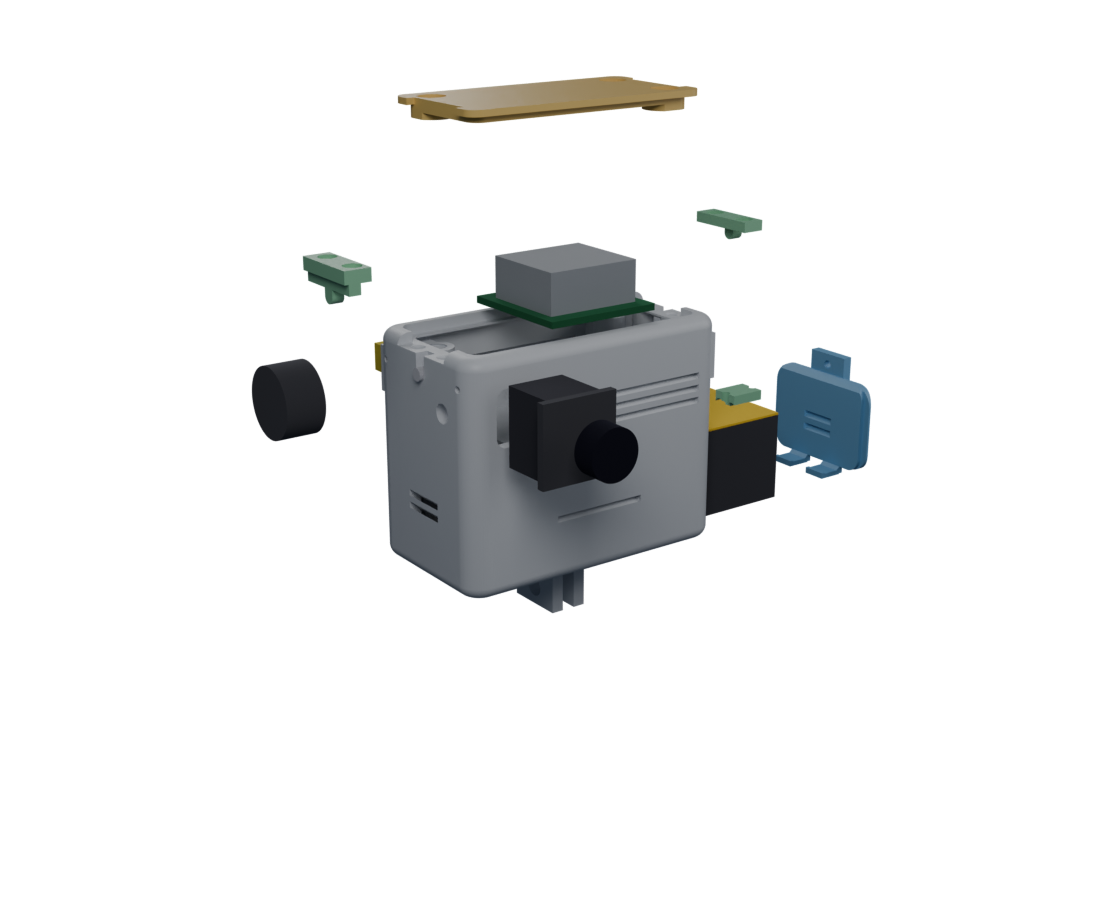
Looks like an action cam — is a 1-watt live transmitter. Camera, radio and swap battery in one printed housing: four off-the-shelf parts, no soldering.

3D view needs WebGL (graphics acceleration). Static view — on the project page the real CAD model spins.
Camera picture in, radio signal out: 1 watt, ~14 ms, 4 km+ with margin. Lives on the upper floor, thermal pad against the housing wall.
Nano format, wide angle. The lens looks flush through a window in the wall — nothing sticks out, nothing snags a canopy.
A 3S LiPo on its own floor — below the radio, thermally separated. Charged externally, swapped in seconds behind the side door. Rails hold it in place in freefall.
The omni sits captive against the housing wall — no free-standing stub, nothing to snag. A T-piece clamps its cable as strain relief.
The ring is the radiation pattern of the sideways antenna — stood upright so the drop zone always sits in the maximum, however she turns in the air.
Barely bigger than a GoPro — holding a true 1-watt radio, the antenna and an all-day swappable battery.
No fan, no sensor, no power spent on cooling: 45° louvers in both walls, the chip hangs on the housing wall. In freefall the 125 mph airstream flushes through — on the ground low TX power, full power only in the jump.
The door sits flush in the wall — a plug in the housing contour, nothing stands in the airstream. Several batteries charge in parallel at the ground station.
Made possible by the sender: 4 km range with margin · ~14 ms — effectively real-time · GoPro mount · all-day via swappable battery · legal on an amateur-radio license.
| SKYLIVE | DJI O3 / FPV | GoPro | |
|---|---|---|---|
| Live picture to the drop zone | Yes, in the open | own goggles/app only | — |
| Onto a big screen / TV | Yes · via HDMI | encrypted → no | — |
| Range | ≈ 4 km | a few km | Wi-Fi ~50 m |
| Latency | ~14 ms | ~30 ms | n/a (recording) |
| Legal on ham license | Yes | gray area | Ja |
| GoPro format on the helmet | Yes | no | Yes |
From her as a radio signal to the antennas, on to the monitor — and via HDMI onto the big TV. 14 milliseconds from the jump to the family in the waiting area.
A monitor on a tripod catches the signal through several antennas — always the one with the strongest picture. Daylight-readable, with a sun hood. Via HDMI the same picture runs straight to the big TV in the waiting area.
Free-space link budget at 5.8 GHz / 1 W. The ground station listens on four antennas at once — 2× X²-Air patch (13 dBic, 150° wide), a helix (13 dBi) and an omni — and switches to the strongest one frame by frame (diversity). Versus a single omni, that adds up to ~11 dB (datasheet gains, free space): at 4 km about +20 dB of margin remains for body shadowing & multipath. (drag the slider · switch the antenna)
Both halves fully engineered — the sender printed, gated, improved through review.
Three sizes fully engineered; every part passes automated print gates.
First print done — external CAD review fully incorporated.
RF, thermal and fit tests, then internal practice jumps.
First real, official tests — 2026 season.
Jumpers, tinkerers, drop zones — let's build the front-row experience.
Free-space path loss (Friis) at f = 5.8 GHz, d = 4 km:
Received power = TX power + antenna gains − losses − FSPL:
Zero margin (free space) only at about 11 km. The 4 km are deliberately conservative — the ~9 dB buffer body shadowing, multipath & polarization. Plus the sideways TX antenna: the drop zone sits in the doughnut maximum, not in the dead zone. And that is the single-antenna math — the 4-bay diversity ground station adds up to ~11 dB on top (see “Range”).
Dissipated power at 1 W RF (~35 % efficiency): Q ≈ 2.5 W. Three paths, all unpowered:
Operating discipline instead of electronics: on the ground the chip transmits at a low setting (HDZero manages its own power), full 1 W only in the jump — where the airstream cools more than any fan could. Graceful: HDZero throttles itself on over-temperature — worst case less picture, never a defect.
The housing is one single printed part (ASA, 3 mm walls) plus door, lid and small parts — no glue, no seam across the housing.
The first prototype is printed; an external CAD review (SolidWorks) has been fully incorporated — including a fracture analysis on the real part and the radii & check rules derived from it. Three sizes share the same proven design.